1. What Does “Wikipedia Approval” Actually Mean?
When people refer to Wikipedia approval, they often assume it means that an article has been published. However, publication alone does not constitute approval. In the context of Wikipedia, approval refers to the review process carried out by experienced volunteer editors and administrators to determine whether an article complies with Wikipedia’s policies and guidelines.
Until a newly created article has been reviewed and accepted through this process, it may not be indexed by major search engines such as Google. In other words, publication is only the first step; the review process is what ultimately determines whether the article is recognized as an accepted part of Wikipedia.
There is no fixed timeline for Wikipedia approval. The review period varies significantly depending on the subject, the quality of the submission, and the current workload of volunteer reviewers. In some cases, an article may be reviewed within a week, while in others, the process can take several months. Since Wikipedia relies on volunteer contributors rather than a dedicated review team, approval times depend largely on reviewer availability and the volume of pending submissions.
2. Average Wikipedia Approval Timeline
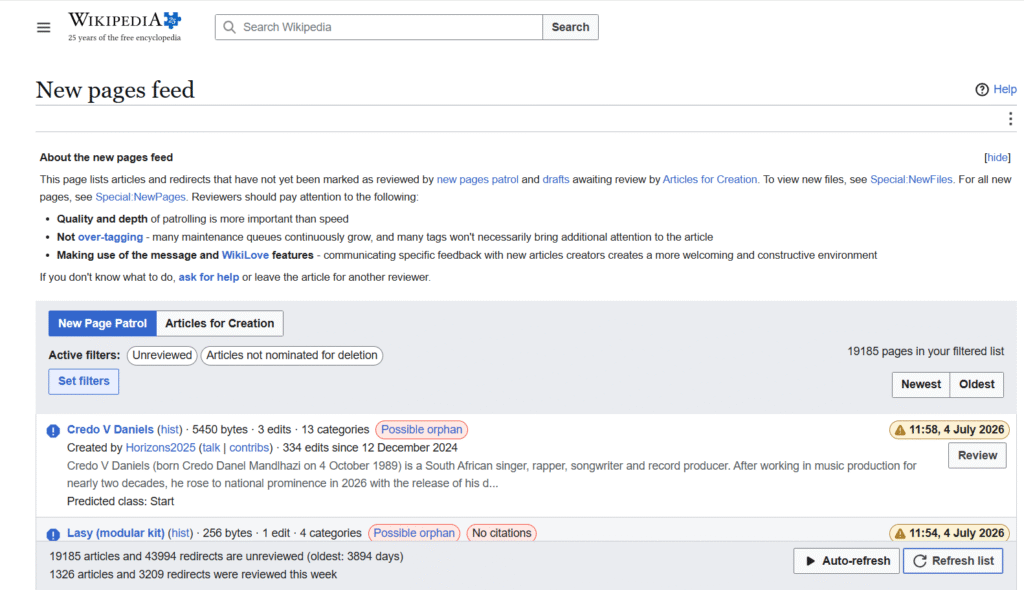
Take a look at the image above, which is based on Wikipedia’s own statistics. At the time of this data, 19,185 articles and 43,994 redirects were still awaiting review, with the oldest unreviewed page dating back 3,894 days (more than 10 years).
It is important to note that this does not necessarily mean that thousands of encyclopedia articles have remained unreviewed for over a decade. The oldest pending pages are likely to include redirects or other types of pages rather than standard encyclopedia articles. However, the data clearly illustrates that some pages can remain in the review queue for a very long time.
The same statistics also show that 1,326 articles and 3,209 redirects were reviewed during that week. This averages to approximately 189 article reviews per day (1,326 ÷ 7). These figures provide a useful indication of the pace at which Wikipedia’s review process operates.
The reason for this relatively modest review rate is that Wikipedia does not employ a dedicated team to review new articles. Instead, the entire review process is carried out by experienced volunteer editors and administrators who contribute their time to the project. As a result, the time required for an article to be reviewed depends not only on the quality of the submission but also on the availability of volunteer reviewers and the size of the review backlog.
3. Factors That Affect Approval Time
As discussed earlier, there is no fixed timeline for Wikipedia approval. The time required for an article to be reviewed varies from one subject to another. Several factors influence how quickly a submission is reviewed, and understanding these can help set realistic expectations.
One of the most common mistakes I have observed throughout my career is that many contributors treat a Wikipedia article like a blog post or a LinkedIn profile. They attempt to include every possible detail about the subject, believing that a longer article is a better article. In reality, this approach often has the opposite effect.
A concise, well-structured article is generally easier for volunteer reviewers to evaluate. Since Wikipedia’s review process is handled entirely by volunteers, reviewers naturally tend to prioritize submissions that can be assessed efficiently. An excessively long article requires more time to verify facts, evaluate sources, and ensure compliance with Wikipedia’s policies, which can result in the submission remaining in the review queue for a longer period.
This does not mean that important information should be omitted. Rather, the article should include only information that is relevant, well-sourced, and necessary to establish the subject’s notability. Additional details can often be added after the article has been accepted and improved over time by the Wikipedia community.
In addition to article length, several other factors can significantly influence the review timeline, including:
- The strength and quality of reliable, independent sources
- Whether the subject clearly meets Wikipedia’s notability guidelines
- The overall quality and clarity of the writing
- A neutral, non-promotional tone
- Proper formatting and citations
- The current backlog of Articles for Creation (AfC) submissions
- The complexity of the subject and the amount of fact-checking required
4. Why Some Pages Are Approved Quickly
Although some Wikipedia articles are reviewed within 24 hours, this should be regarded as the exception rather than the rule. Since Wikipedia’s review process is managed entirely by volunteer editors and administrators, there is no mechanism to request or expedite a review. Neither the article creator nor a third party can influence when a reviewer will assess a submission.
When an article is reviewed quickly, it is usually because it meets several key criteria that make the review process straightforward. These include:
- The subject is clearly notable, with ample coverage in reliable, independent sources.
- The content complies with Wikipedia’s policies and guidelines, including its standards for neutrality, verifiability, and notability.
- The article is well-formatted and properly organized, making it easy for reviewers to evaluate.
- The article has been created by an experienced Wikipedia editor with a history of constructive contributions. While experienced editors do not receive preferential treatment, they are generally more familiar with Wikipedia’s requirements and are therefore more likely to submit policy-compliant articles that require fewer revisions.
When these factors are present, reviewers can assess the submission more efficiently, increasing the likelihood of a faster review.
5. Why Some Pages Take Months
Based on my experience, one of the most common reasons for delays is that contributors try to include excessive detail in a Wikipedia article, treating it more like a comprehensive blog post than an encyclopedia entry. I have worked with clients who were reluctant to remove even a single sentence after I explained that certain content did not comply with Wikipedia’s editorial standards. They often believed that every piece of information was essential, even when much of it was unnecessary for an encyclopedic article.
In reality, Wikipedia values concise, well-sourced, and relevant information over lengthy narratives. An article that is overloaded with detail requires more time for reviewers to verify facts, assess sources, and ensure compliance with Wikipedia’s policies, which can result in a longer review period.
In addition to excessive article length, other common reasons for delayed reviews include:
- Weak or unreliable sources: Articles that rely on self-published material, press releases, or sources that do not meet Wikipedia’s reliability standards often require additional scrutiny.
- Copyright violations: Some contributors upload copyrighted images without permission or copy text directly from other websites. Since Wikipedia has strict copyright policies, such submissions are likely to be delayed, declined, or even deleted.
- Promotional language: Wikipedia requires a neutral point of view. Phrases such as “one of the best,” “the first,” “world-class,” “industry-leading,” or “one of a kind” are considered promotional unless they are directly supported by high-quality, independent sources and presented in an encyclopedic manner.
By keeping the article concise, using reliable independent sources, respecting copyright, and maintaining a neutral tone, contributors can significantly improve the chances of a smoother and more efficient review process.
6. Can You Speed Up Wikipedia Approval?
If anyone claims they can have your Wikipedia article reviewed within a day—or even within a specific week—you should treat that claim with caution. The timing of Wikipedia’s review process is entirely outside the control of article creators, consultants, and third parties. Since reviews are conducted by independent volunteer editors and administrators, no one can legitimately guarantee that an article will be reviewed on a particular date.
Occasionally, someone may claim to have personal connections with Wikipedia reviewers or administrators who can expedite the process. If such coordination were to occur, it would conflict with Wikipedia’s principles of impartiality and community governance. Editors are expected to review articles independently and without favoritism. Any attempt to manipulate the review process could attract scrutiny from the Wikipedia community and may result in the article being flagged, re-evaluated, or, in serious cases, deleted.
For this reason, the best approach is to submit a well-researched, policy-compliant article and allow it to proceed through Wikipedia’s standard review process. While the waiting period can vary, following the normal review procedure is the safest and most reliable way to achieve a lasting, compliant Wikipedia article.
7. Frequently Asked Questions
- Can a Wikipedia page be approved in one day?
No one can claim, maybe this happens in a reviewer luckily reviews the page. I am just talking about he review process here, not the whole process of getting a page approved from scratch. Like working on a new page’s article takes around 2 weeks for content writng and then once a page is created on Wikipedia, it may be sometimes reviewed within a day.
- Why is my draft still pending review?
There is no fixed time for review. It all depends on availability of reviewers and administrators.
- Can I contact reviewers directly
No.
- How many times can I resubmit?
There inst any limit for submissions, you can submit it many times you want. But if you violate the Wikipedia rules again and again they may restrict the way of page creation, i.e they will lock the page creation and only Admins will be able to create a page.
- Will hiring a professional make approval faster?
Yes, an experienced Wikipedia editor can often improve the quality of a submission because they understand Wikipedia’s policies, guidelines, and editorial standards. They know how to:
- Write content in a neutral, encyclopedic tone.
- Format articles correctly using Wikipedia’s markup language.
- Insert and format citations properly.
- Avoid promotional language and unsupported claims.
- Include only information that is relevant and supported by reliable, independent sources.
- Keep the article concise and appropriately structured, making it easier for volunteer reviewers to assess.
Professional Chanley Painter Wikipedia page creation note:
WikiProTeam with more than a decade of experience can create a page on any subject in any language for you.