This section is based on my personal experience and observations rather than generic AI-generated content. I would encourage you to read it with that perspective in mind.
Why there is no official Wikipedia fee
To begin with, it is important to understand that Wikipedia’s Terms of Use require editors who receive compensation for their contributions to disclose that paid editing. Simply hiring someone to create or edit a Wikipedia page does not, by itself, violate Wikipedia’s policies, provided that the required disclosure is made and all Wikipedia content policies are followed. In practice, however, many businesses and individuals hire freelancers or agencies to assist with Wikipedia-related work.
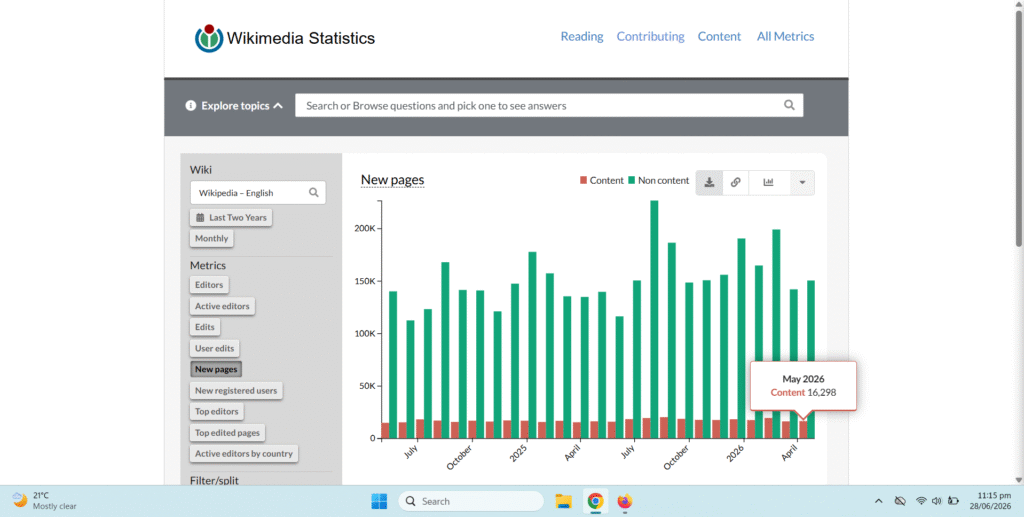
Let’s look at the numbers. According to Wikipedia statistics, 16,298 new articles were created in May 2026. While it is impossible to determine precisely how many of these were created with paid assistance, it is widely recognized that a substantial number of articles are prepared by professional writers, consultants, and agencies working on behalf of clients.
Have a look at the graph below.
What professional services actually charge
A common question is why there is no standard fee for Wikipedia page creation. The answer is simple: pricing varies significantly depending on the service provider. Every freelancer or agency sets its own rates based on factors such as operating costs, expertise, reputation, and the scope of work involved.
For example, agencies based in the United States often charge between US$1,000 and US$2,000 for a complete Wikipedia page creation service. In contrast, freelancers and agencies operating in parts of Asia or Africa may charge anywhere from US$500 to US$1,000 for comparable services. Even within the same region, pricing can vary considerably from one provider to another.
What affects pricing
In my experience, the cost of a Wikipedia project is generally influenced by two primary factors:
- The location and operating costs of the freelancer or agency.
- The complexity of the subject.
The first factor has already been discussed above. The second factor—the complexity of the subject—can have a significant impact on the amount of research and time required.
For instance, suppose you want to create a Wikipedia page for Aileen Smith. There may be numerous individuals with the same name across various online sources. Identifying reliable references that relate specifically to the correct person requires careful research and verification, which naturally increases the workload.
The process becomes even more challenging if a Wikipedia article already exists under the title “Aileen Smith.” Since Wikipedia does not permit two articles with identical titles, the new page would require a disambiguated title, such as “Aileen Smith (writer)” or “Aileen Smith (actor).”
Choosing a disambiguated title can introduce additional challenges. Search results for the more specific title may be less extensive than those for the person’s name alone, making it more time-consuming to locate and verify reliable sources that clearly establish the subject’s notability. As a result, projects involving common names or title conflicts often require substantially more research and editorial effort than subjects with unique names.
DIY vs professional creation
Based on my experience, I generally recommend hiring an experienced Wikipedia editor or consultant if you are serious about creating a Wikipedia page. While many people attempt to create their own articles to save money, they often encounter challenges that result in the page being rejected, declined through the Articles for Creation process, or deleted. At that stage, recovering from the initial setback can be significantly more difficult.
Having worked with Wikipedia for more than a decade, I have observed that articles with a history of rejection or deletion often receive closer scrutiny from experienced editors. Any subsequent submission is expected to address the issues that led to the original rejection, and the burden of demonstrating the subject’s notability becomes even greater. Although it is certainly possible to recreate a previously deleted article, the process usually requires substantially more time, stronger sourcing, and greater attention to Wikipedia’s policies.
There are several reasons why working with an experienced editor can improve the chances of a successful submission.
1. Wikipedia Content Writing Is Different from Conventional Writing
Writing for Wikipedia is very different from writing a blog post, company profile, or marketing article. Wikipedia requires a neutral point of view, relies exclusively on independent and reliable sources, and prohibits promotional language. Even well-written content can be rejected if it does not comply with these editorial standards.
2. Identifying Reliable Sources Requires Experience
One of the most challenging aspects of creating a Wikipedia article is identifying and selecting appropriate sources. New contributors often struggle to distinguish between reliable, independent sources and those that Wikipedia considers unsuitable, such as press releases, self-published content, or company websites. An experienced editor understands which sources are likely to satisfy Wikipedia’s notability requirements.
3. Wikipedia’s Formatting Has a Learning Curve
Wikipedia articles must be written and formatted using Wikipedia’s markup language and editorial conventions. This includes citations, templates, categories, infoboxes, and other technical elements. For someone unfamiliar with Wikipedia, learning these requirements can be both time-consuming and challenging.
4. Conflict of Interest Can Affect the Review Process
If you create an article about yourself, your company, or a client using your personal account, it may raise concerns about a Conflict of Interest (COI). While having a conflict of interest does not automatically prevent an article from being accepted, Wikipedia expects contributors to disclose paid editing where applicable and to avoid directly promoting the subject. Failure to follow these guidelines can increase the likelihood of the article being questioned, rejected, or removed.
For these reasons, many individuals and organizations choose to work with experienced Wikipedia professionals who understand the platform’s policies, sourcing requirements, and editorial expectations. While no one can legitimately guarantee that a Wikipedia article will be accepted, professional guidance can help avoid common mistakes and improve the quality of the submission.
Hidden costs of failed submissions
Discuss the Pricing and Scope of Work in Advance
Before hiring a freelancer or agency, it is essential to discuss the pricing structure and scope of work in detail. As mentioned earlier, Wikipedia projects differ significantly from standard content writing assignments.
With a blog or website article, you provide instructions to a writer, they complete the work, and you have the final authority to accept or reject the deliverable. Wikipedia, however, operates very differently. Even if the article is professionally researched and written, the final decision regarding its acceptance rests with the Wikipedia community and its volunteer editors—not with the freelancer or the client.
For this reason, it is important to clarify the terms of the engagement before the project begins. Specifically, ask the following questions:
- What happens if the article is declined or deleted?
- Does the quoted fee include revisions or resubmissions?
- Will there be any additional charges if further work is required?
- Is the project offered at a fixed price, or will extra fees apply if another submission becomes necessary?
Having these points agreed upon in advance helps prevent misunderstandings and unexpected costs later. Some freelancers charge separately for revisions or resubmissions, while others offer a fixed-price service that includes reasonable follow-up work. Understanding the freelancer’s policy from the outset allows you to make an informed decision and avoid disputes during the project.
A clear agreement on pricing, deliverables, and post-submission support benefits both the client and the service provider, ensuring that expectations are aligned from the very beginning.
What I do when I create a Wikipedia page
The first principle I follow is that I only accept projects when, after conducting a thorough assessment, I am confident that the subject meets Wikipedia’s notability requirements and has a strong likelihood of being accepted. This approach helps set realistic expectations and minimizes the risk of disappointment for both the client and myself.
Secondly, in the unlikely event that the article is removed despite meeting the necessary requirements, I will recreate and resubmit the page at no additional cost. My goal is to provide continued support throughout the process and ensure that my clients receive the best possible service.