In a striking example of how internet culture, high-stakes tech rivalry, and billionaire influence intersect in the digital age, Elon Musk has confirmed his offer to rename Wikipedia — one of the most visited websites in the world. The offer, which sounds almost surreal, has drawn widespread attention, debate, and plenty of online debate since it first emerged and resurfaced again in late 2024 and early 2025. But what exactly is going on? Let’s break it down.
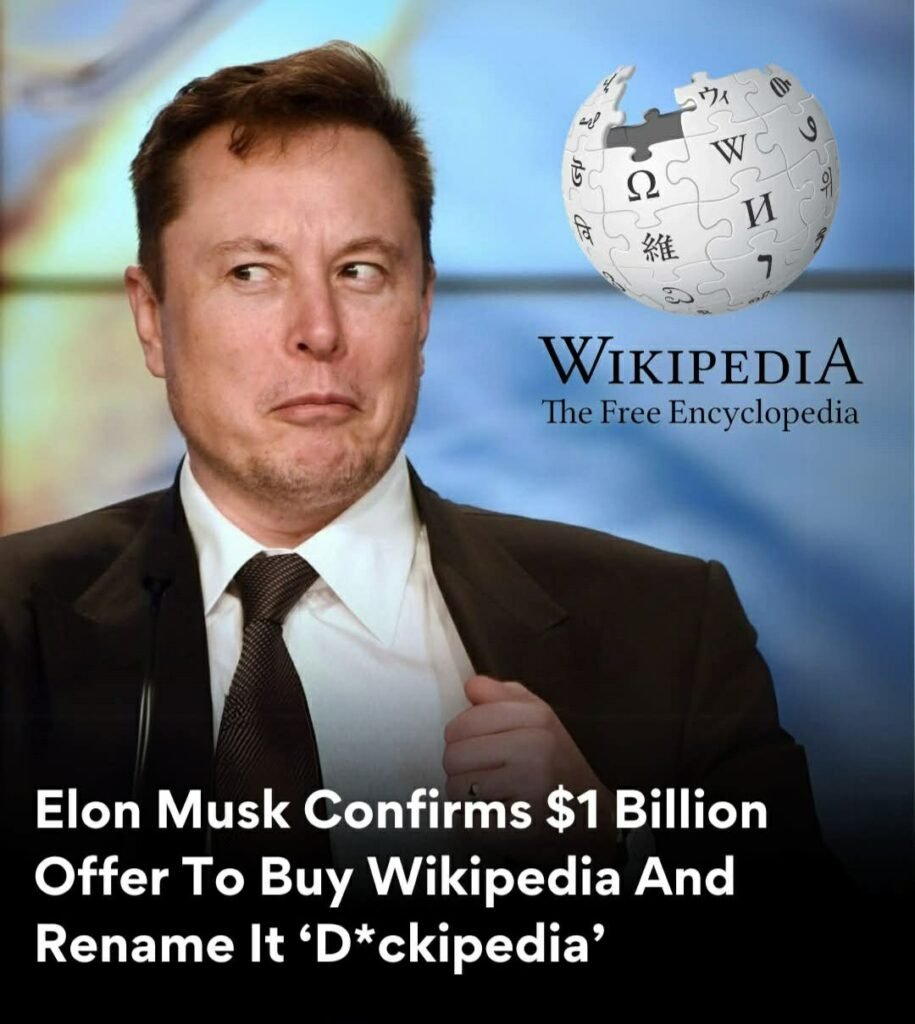
The Strange Offer: A Billion Dollars for a Name Change
At the center of this unusual story is Elon Musk, the billionaire entrepreneur behind Tesla, SpaceX, X (formerly Twitter), and the AI company xAI. Musk publicly stated that he would be willing to donate $1 billion to Wikipedia — but only if the online encyclopedia agrees to rename itself. His suggested new name? A provocative one: “Dickipedia.” (The Times of India)
Musk reiterated the offer on social media platform X in response to users asking whether the proposal was still active. When asked, he confirmed that the offer “still stands,” signaling he remained serious — or at least persistent — about his challenge. (The Times of India)
This is not a fleeting social media joke. Multiple news outlets confirmed over months that Musk reaffirmed the offer and clarified that the name change would have to be in place for at least a year. (The Times of India)
Why Did Musk Make This Offer?
1. Criticism of Wikipedia’s Funding Model
Part of Musk’s motivation stems from criticism of the Wikimedia Foundation, the nonprofit organization that operates Wikipedia. Musk has questioned why the foundation solicits large donations from the public when Wikipedia’s operating costs, in his view, are comparatively modest.
In a social media post, Musk suggested that the entire content of Wikipedia could easily fit on a modern smartphone, implying that the foundation’s fundraising appeals were excessive. (The Economic Times)
2. Disagreements Over Perceived Bias
Musk has also accused Wikipedia of ideological bias. Some of his comments imply that the platform leans toward certain political viewpoints, an assertion disputed by many editors and observers who point to Wikipedia’s community-driven editorial model and strict neutrality policies. But this perception of bias is a key part of why he entertained such an unconventional offer. (News.az)
3. A Provocative Branding Move
It is worth noting that the name Musk proposed isn’t just a name — it’s a provocative internet meme. The term “Dickipedia” is intentionally humorous, designed to spark conversation and perhaps even ridicule. Whether it was meant as satire, a serious negotiation tactic, or something in between is part of what makes this story so newsworthy.
Has Wikipedia Responded?
As of now, Wikipedia and the Wikimedia Foundation have not accepted the offer or announced any intention to rename the platform. The foundation’s public stance is that the site is not for sale, emphasizing its long-standing commitment to being a free, independent, and nonprofit resource. (The Economic Times)
Wikipedia’s editorial community functions through volunteers around the globe, not corporate decision-makers. This decentralized structure makes the idea of even discussing a name change — let alone agreeing to one for pay — highly unlikely.
Context: Musk’s Broader Encyclopedia Ambitions
The Wikipedia name offer is only part of a larger narrative in which Musk has challenged the notion of how information should be curated and distributed online.
In October 2025, Musk’s company xAI officially launched a website called Grokipedia, billed as an AI-powered alternative to Wikipedia. (ערוץ 7)
Grokipedia aims to provide a searchable encyclopedia fueled by AI, using content sourced from various places and built with a design reminiscent of Wikipedia’s simplicity. Early data shows that the platform launched with a fraction of Wikipedia’s size — just under a million articles compared to Wikipedia’s millions — and has attracted a burst of initial interest. (Wikipedia)
The existence of Grokipedia underscores that Musk’s interest in challenging Wikipedia is not just rhetorical. He and his team seem intent on providing a true alternative that they argue can outperform the established encyclopedia — though critics have pointed out issues with sourcing, quality, and AI dependence. (Dexerto)
Public and Industry Reaction
Mixed Social Responses
Reactions to Musk’s offer have ranged widely online. Social media commenters have alternately mocked the idea, praised Musk’s boldness, or criticized him for perceived ego-driven antics. Some argue that such offers trivialize serious discussions about online knowledge and the importance of reliable information.
Others see Musk’s persistent trolling of major internet platforms — from Twitter/X to Wikipedia — as part of his broader strategy to disrupt traditional institutions and push his own alternatives.
Academic and Media Commentary
Journalists and tech analysts point out that while Musk’s offer is unlikely to ever be accepted, it highlights genuine debates about information neutrality, the role of corporate power in digital spaces, and the future of AI in knowledge creation. Whether Grokipedia can ever meaningfully compete with Wikipedia’s volunteer-driven model remains an open question.
What This Means for Wikipedia
For its part, Wikipedia continues to be a cornerstone of online information, with millions of articles in hundreds of languages and a community committed to neutrality and free access. The Wikipedia brand — recognized globally — is one of its most valuable assets. The idea of changing that name for financial gain runs counter to its mission of providing free and unbiased knowledge. (The Economic Times)
Conclusion: More Than a Meme — A Cultural Moment
The phrase “Elon Musk has confirmed his offer to rename Wikipedia” isn’t just clickbait. It represents an infamous episode where internet culture, ranting billionaire antics, and the future of online information collided.
While Wikipedia is extremely unlikely to change its name, the offer reflects broader themes in tech today: disputes over bias and authority, the rise of AI-driven alternatives, and the outsized influence a few individuals can have on public discourse.
As the digital ecosystem continues to evolve, so too will the conversations about who controls knowledge — and what it should be called.